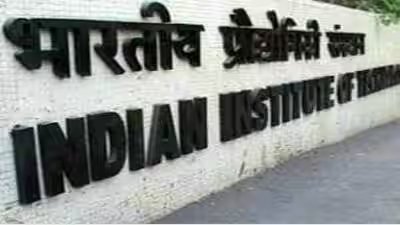
Veezhinathan Kamakoti, dean of IIT Madras, said that artificial intelligence can support the preparation process of national entrance examination papers, but it cannot independently replace human expertise, stressing that expert review remains indispensable at every stage of examination preparation.Talking about the evolving role of artificial intelligence in the examination system, Kamakoti said that artificial intelligence may create potential problems, but these will still require rigorous scrutiny by subject experts before it can be used in actual examinations.“I don’t think AI can develop exam papers on its own. AI may be able to generate questions, but someone will still need to review them,” he said.His comments come as educational institutions and exam bodies across the country are increasingly exploring AI-powered tools for academic and administrative functions. Kamakoti, however, warned that relying solely on artificial intelligence for national-level entrance exams would not be appropriate.
Human oversight is critical multilingual exam
Underlining the difficulty of the National Eligibility cum Entrance Test (NEET), Kamakoti emphasized that the exam is conducted in 12 different languages. He mentioned that quality control is necessary in this case because translating a question from one language to another should not change its meaning.“NEET is very inclusive in this sense. It is conducted in 12 languages, so someone has to verify the translation as well. AI can certainly assist in the translation, but someone has to double-check the translation,” he said.The comments highlight one of the biggest challenges facing the Indian exam ecosystem, which is maintaining consistency and accuracy across multiple languages while ensuring fairness for millions of candidates.
Artificial intelligence could complement, not replace, exam experts
According to Kamakoti’s observation, AI should not be seen as a substitute for academic expertise but as an enabler technology. While AI systems can be used to facilitate some activities such as question generation, translation and content processing, decisions on issues such as question quality, difficulty level, factual and linguistic accuracy must remain in the hands of academic experts and experts.Furthermore, his observation is consistent with the overall philosophy of exam reform, which is to use technology to increase efficiency and transparency while ensuring academic standards and the integrity of the college entrance examination.Kamakoti’s comments are pertinent given the increasing use of artificial intelligence in education, especially in areas such as assessment that determines admissions to professional courses and impacts the careers of millions of students every year.