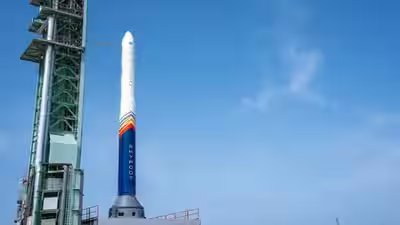
On July 18, 2026, Skyroot Aerospace’s Vikram-1 satish dhawan space center, sriharikotaand will deliver its payload into an orbit of nearly 450 kilometers approximately 15-17 minutes after liftoff. The mission, dubbed “Aagaman” (Sanskrit for “arrival”), was the first flight of Vikram-1, India’s first privately developed orbital-class launch vehicle. With this launch, India becomes the third country in the world to have private orbital launch capabilities after the United States and China. Prime Minister Narendra Modi congratulated Skyroot Aerospace for its achievement and IN-SPACE Chairman Pawan Goenka termed it “India’s moment”.
break it down
Until recently, only government agencies such as ISRO could design, build and launch orbital rockets in India. Vikram-1 changed that. This is a rocket built entirely from design to manufacturing to final assembly by the private Indian company Skyroot Aerospace. The rocket is named after Dr. Vikram Sarabhai, the father of India’s space programme.Think of it this way: ISRO’s PSLV and GSLV are like government-run trains that carry satellites into space on a fixed schedule. Vikram-1 is Skyroot’s attempt to provide a “taxi” service, a smaller, faster, on-demand ride for small satellites that need to reach specific, customized orbits quickly.Vikram-1 is not India’s first private rocket. That distinction belongs to Vikram-S, a smaller single-stage suborbital rocket launched by Skyroot in November 2022 under the Prarambh mission. Vikram-1 goes one step further. It’s a fully orbiting vehicle, meaning it can carry satellites all the way into Earth orbit, not just to the edge of space and back.
mechanism
Vikram-1 is a four-stage rocket about 20-24 meters tall and is mainly made of carbon composite materials to keep its weight light. The stages are:
- The three solid fuel stages are named Kalam-1200, Kalam-250 and Kalam-100 after former president and rocket scientist Dr. APJ Abdul Kalam. These provide the initial thrust to climb out of the atmosphere.
- The final stage is the liquid-fueled Orbital Adjustment Module (OAM), which uses a 3D printed engine. Unlike solid stages that are launched once, OAMs can be started, stopped, and restarted in space, allowing for precise delivery of satellites into target orbits over the last mile.
The rocket is designed to carry payloads weighing up to 350 kilograms to a low Earth orbit (LEO) of approximately 450 kilometers. On its maiden flight, it carried technology demonstration payloads from companies including Grahaa Space, Cosmoserve Space and Germany’s DCUBED, as well as symbolic cargo including a handwritten postcard from Prime Minister Modi and a lab-grown diamond artwork.Aagaman is described as a test flight, the first of three planned development flights designed to validate the rocket before Skyroot begins regular commercial launches.
Relevant Agencies, Laws and Policies
- ISRO (Indian Space Research Organization): Indian National Space Agency. For Vikram-1, ISRO is supporting the private mission through facilities such as engine casting, liquid engine testing, trajectory analysis and use of Sriharikota launch pad.
- IN-SPACE (Indian National Space Promotion and Authorization Centre): An autonomous, single-window nodal agency under the Ministry of Space, established in 2020. It authorizes and regulates India’s private sector space activities, including granting launch licenses to companies such as Skyroot.
- Department of Space (DOS): The central government department responsible for overseeing India’s space program, ISRO and IN-SPACE both operate under the programme.
indian space policy 2023: This policy officially opens the space sector to private participation across the entire value chain, from building satellites and launch vehicles to providing launch services, with ISRO focusing more on research, exploration and technology development.- New Space India Limited (NSIL): A public sector undertaking under DOS responsible for commercial marketing of ISRO’s technology and production of launch vehicles through Indian industries.
What it means to India
Vikram-1’s success is a milestone in India’s space sector reforms, which began in 2020 when the sector was opened to private industry. This marks a sign that private Indian companies can now compete in the global small satellite launch market, which is growing rapidly as demand for Earth observation, communications and technology demonstration satellites increases. A successful private launch ecosystem would also allow ISRO to focus its resources on larger strategic missions such as the Gaganyaan human spaceflight programme, planetary exploration and heavy-lift launch vehicles, while private players take care of smaller and more frequent commercial launches. Founded in 2018 and headquartered in Hyderabad, Skyroot is one of India’s leading aerospace technology startups and had previously achieved the Vikram-S milestone in 2022.
preliminaries fact box
Power exercises
“The success of Vikram-1 reflects the maturity of India’s private space sector.” Discuss reforms to enable private participation in India’s space program and examine the opportunities and challenges this poses for ISRO and private players in the future. (250 words)
quick quiz
Q1. Please consider the following statements regarding Vikram-1:
- It is India’s first privately developed orbital-class launch vehicle.
- It was launched from the Satish Dhawan Space Centre.
- It uses only liquid propulsion in all stages.
Which of the above statements are true? (a) 1 and 2 only (b) 2 and 3 only (c) 1, 2 and 3 (d) 3 onlyAnswer: (a) Vikram-1 uses three solid fuel stages and a liquid fuel orbital adjustment module instead of full liquid propulsion.Q2. The mission “Aagaman” is related to which of the following?(a) ISRO’s Gaganyaan program (b) Skyroot Aerospace’s Vikram-1 first orbital flight (c) NSIL’s commercial satellite launch (d) India’s first lunar sample return missionAnswer: (b)Q3. Which agency authorized private launch of Vikram-1?(a) Ministry of Space (b) ISRO (c) IN-SPACE (d) NSILAnswer: (c) IN-SPACE is the single window nodal agency for authorizing private space activities in India.Q4. After which character is Vikram-1 named?(a) Dr. APJ Abdul Kalam (b) Dr. Vikram Sarabhai (c) Dr. Satish Dhawan (d) Dr. Homi J. BhabhaAnswer: (b)Q5. With the successful orbital launch of Vikram-1, India has become the first country in the world to have private orbital launch capabilities.(a) First (b) Second (c) Third (d) FourthAnswer: (c) After the United States and China.
Five key terms to remember
- Orbital Adjustment Module (OAM): Vikram-1’s liquid-fueled final stage delivers payloads precisely into target orbits and can be relaunched in space.
- In space: An autonomous nodal agency that authorizes and regulates the activities of India’s private space sector.
- Low Earth Orbit (LEO): Orbiting the Earth, the altitude is typically less than 2,000 kilometers; Vikram-1’s target distance is about 450 kilometers.
- Indian Space Policy, 2023: Policy framework for opening up India’s space sector, including launch vehicles, to private companies.
- New Space India Limited (NSIL): The commercial arm of the Indian Space Ministry, which sells ISRO technology and supports industrial manufacturing of launch vehicles.