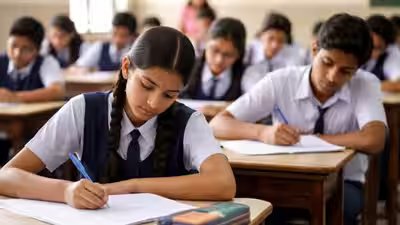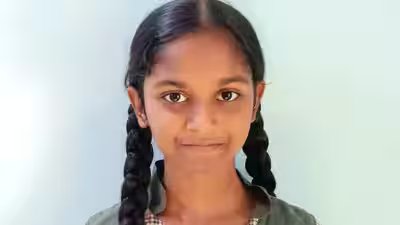
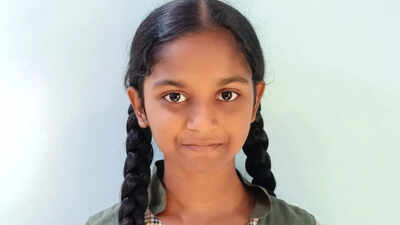
In a government school classroom in Douleswaram, a physical science teacher noticed something about a Class 10 student that eventually led her to New Delhi and possibly one day to the Indian Space Research Organization (Indian Space Research Organization).That student was Kandula Jesse. The 14-year-old daughter of a carpenter is one of 20 Indian participants selected for Mission ShakthiSAT, the world’s first all-girl lunar CubeSat mission. She is also the only Andhra student to make it to the final list from India, which was selected from nearly 12,000 registered students from 108 countries.Every story is not a story of early advantage. It’s a teacher’s concerns, a family’s financial struggles, and a student who keeps showing up to online classes after school, even when the concepts are well beyond her understanding.
The teacher I saw first
Jessie studies at Zilla Parishad Girls’ High School (ZPGHS) in Doyleswaram, and it was here that her science teacher Manimala first enrolled her in the program last year at the school’s Atal Tinkering laboratory.Manimala noted Jesse’s consistent interest in science and innovation, as well as her active participation in lab activities and competitions. Jesse didn’t stop applying for himself. She encouraged eight other students at the school to sign up as well. But when they tried to join, they found that online classes had already begun. Manimala contacted the program coordinator directly and was offered a second chance, which allowed Jesse to proceed.
What it actually takes to be selected
Selection for Mission ShakthiSAT is not a matter of filling in a form and waiting. It involves online learning modules covering approximately 550 courses and 21 modules covering satellite systems, propulsion, thermodynamics and space technology. Applicants must also pass one-hour interviews with scientists and coordinators and submit a one-minute video explaining their mission and the importance of science, technology, engineering and mathematics (STEM) education.Jessie successfully completed nearly 50% to 60% of her coursework while also preparing for her Class 10 exams and attending online classes every day after school.“I found a lot of the concepts difficult at first as they were much more advanced than what we learn in school, but I continued to attend classes every day,” Jesse told TOI.The interview added another layer of difficulty. The event was conducted entirely in English with international experts, and Jess worked hard to improve her communication skills with the help of teachers and educational videos.“I was nervous talking to international scientists. I never thought a public school student like me would be chosen,” she said.
A family formed due to financial constraints
Jesse’s father was a carpenter. According to her mother Aruna, the family had to transfer Jesse from private school to a public school due to financial constraints.It was at that public school, in a lab designed to introduce students to tinkering and innovation, that a teacher discovered her potential. This could have been interpreted as a setback, but it turns out that Jesse’s interest in science can be noticed and encouraged.“My husband is a carpenter and we faced many difficulties. Seeing my daughter confidently interact with international scientists was one of the proudest moments of our lives,” Aruna said.
what happens next
Jesse will travel to New Delhi from August 23 to take part in the next phase of the project, which includes practical training and National Space Day celebrations. There, she will work with scientists on satellite design, payload development and mission operations for the student-built Lunar CubeSat, a small satellite designed to orbit the moon and scheduled for launch from Sriharikota on October 11.Jesse is also hoping to attend an event where Prime Minister Narendra Modi is expected to attend.“After being selected for this programme, I feel that with hard work, I can realize my dream of joining ISRO. I also want to support my parents and make my teachers and school proud,” she said.
About ShakthiSAT Mission
Mission ShakthiSAT is led by Dr. Srimaty Kesan, founder and CEO of Space Kidz India, an organization dedicated to educating youth about space science. The mission aims to encourage girls to pursue STEM careers through hands-on experience in space science, satellite technology and international collaboration, according to its official website.For Jessie, it’s been more than that. It turned a public school student’s daily after-school endeavor into a real career opportunity in space science.