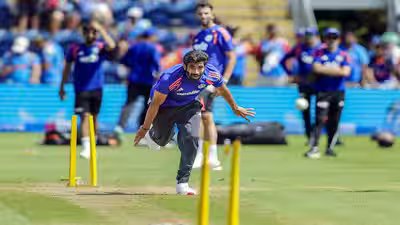
TimesofIndia.com LONDON: Jacob Bethell and Ben Duckett relaxed into a warm, pleasant and sunny morning at the Lord’s Cricket Ground on Sunday. After winning the coin toss, the duo started slowly but picked up the pace as the game progressed in the third ODI against India. ardeep singh and Prasidh Krishna Jasprit Bumrah, who was sidelined with a left knee injury during the second ODI, has been given new ball-keeping responsibilities. Reactive swelling in his left knee kept India’s top seamer out of the game and Arshdeep took his place in the series decider.Krishna filled the void with back-to-back maiden balls as he found his line, length and extra bounce. Twenty consecutive penalties defined the 30-year-old’s day. Unfortunately, the struggle to find wickets or apply pressure by stemming the flow of runs continued as Bumrah wasn’t there to help the effort from the other side and no one came remotely close to what ‘Boom’ had to offer.Prince Yadav, who came in for the injured Washington Sundar in only his third ODI, started with 11 runs, including a huge outside catch that evaded a desperate save from wicketkeeper Ishan Kishan.If the uneventful bowling wasn’t enough, the additional extra overs further worked in England’s favour. India gifted 26 extra players, including 16 wideouts and nine leg byes.“That pretty much sums up India’s bowling and the day’s performance so far,” former England captain Nasser Hussain said in his commentary after Prince Yadav’s long-on delivery in the 28th over was flicked to fine leg by Besser for a boundary. “India will be very disappointed with their bowling today; they were very ordinary,” he admitted Ravi Shastri soon.The 192 games between Bethell and Duckett broke multiple records. This is England’s first century stand in an ODI since 2023. This was England’s biggest stand against India in ODIs. At Lord’s Stadium, it was the first time since 2010 that the host team played a full-time stand. It is also the biggest ever first-wicket partnership at the iconic venue.Duckett noted his milestone before he lost to Prince Yadav, who scored 141 off 135 balls. Nothing would be more important than surpassing Viv Richards’ highest scoring record of 138 points set at this venue in the 1979 World Cup final.England’s score of 387/3 was their largest ODI score at Lord’s since the first World Cup in 1975. The day became more famous when Sunil Gavaskar scored 36 off 174 balls in a chase of 335 runs.Unlike Gavaskar, Root, another legend of the sport, chose to perform brilliantly, scoring an unbeaten 74 off 48 balls. Root scored his sixth consecutive ODI fifty as India failed to bowl them out even once in the 50-over series. Root scored 249 runs in three innings and India came close to bowling him out.The damage was done by the first-wicket partnership, intensified in the middle overs, and the result was all but confirmed in the end. The power play scored 58 points; the score in the middle overs was 203/1 and the score in the last 10 overs was 126 points, of which 62 points were scored in the last three overs.Not surprisingly, the bowlers bled. Gurnoor Brar conceded 97, Prince 79, Arshdeep 72 and even bowler Prasidh, who had two wickets, conceded 69, most of which came in tough matches.As Prasidh’s penalty spell showed, when bowling was disciplined, on a surface that was supportive of the seamers, India were inconsistent and paid the price. The Men in Blue, who fielded five frontline bowlers, missed Bumrah badly and also decided to keep Kuldeep Yadav on the bench once again. The wrist-spinner has played just eight out of 15 ODIs since India successfully lifted the Champions Trophy. His ability to drive through the midfield is crucial to India’s winning formula. However, he was not introduced as India struggled to contain the runs during the period and barely squeezed out a wicket. The 31-year-old has played in all three net matches ahead of the first ODI at Edgbaston and is also busy in the option stages ahead of the series-deciding third match. With Sundar injured, Kuldeep was considered an ideal replacement. Unfortunately, this is not the case.“If you are a team that can take wickets in the middle stages of the game, you are in a very good position going into the latter stages of the game. Likewise with the bat, if you are a strong enough team that can spin as a batting unit and pick up boundaries here and there, then you can go into the last 10 overs and that can have a huge impact on the game,” England captain Harry Brooke said before the third ODI.Unfortunately, India’s hopes of winning the 2027 ODI World Cup did not continue to challenge in these mid-match matches. In the three ODIs against New Zealand, the odds in the middle overs are: 163/5, 193/2 and 191/1. The situation improved again in the previous games against Afghanistan and looked terrible against England: 152/6, 146/4 and 203/1.India’s seam bowling looked lackluster without Bumrah. The day at Lord’s was more like Sunday cricket, with the bowlers going through their motions without thinking. Most of the shipments were fully loaded and 105 shipments were dispatched on time. At the other end of the pitch, India seamers bowled 38 short balls and were bowled for 87 runs with an economy rate of 13.73. When the bowlers did bowl correctly on 77 balls, they conceded 58 runs.Ultimately, the target of 388 runs proved to be a bridge too far. This wasn’t just the result of a bad outing. Bumrah’s absence exposed India’s lack of dynamism in the pace attack, but perhaps the bigger concern remains India’s inability to wrest control through the middle. While England’s batsmen clearly executed their plan, India searched for answers, insisting on a combination that repeatedly failed to stop runs. With 15 months to go before the 2027 ODI World Cup, these recurring questions are less about experimentation and more about missed opportunities to nail down a bowling formula that can consistently take wickets, apply pressure and win matches.