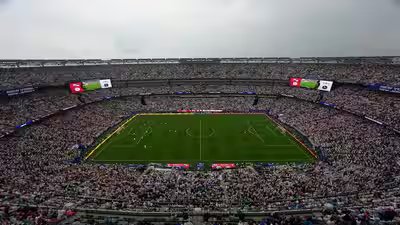
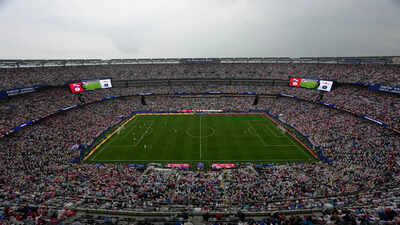
As Argentina and Spain prepare to face off for the FIFA World Cup title in East Rutherford on Sunday, another key player is the subject of intense scrutiny – the pitch.The mixed turf at New York-New Jersey Stadium has elicited mixed reactions throughout the tournament, with players and coaches offering contrasting opinions after seven World Cup games at the venue. Some described it as too fast, hard and uneven, while others thought the rain turned it into one of the better surfaces to race on. Neither Argentina nor Spain are playing at the stadium during this World Cup, adding an extra layer of intrigue to the final, with the condition of the pitch likely to affect tactics and style.With heavy rain expected on Saturday and sunny weather on match day, the venue remains one of the biggest unknowns in football’s biggest game.
Fast, determined, unpredictable: the player experience
One theme that players and coaches come up with repeatedly is the speed of mixed turf.England manager Thomas Tuchel described it as “very fast” and compared it to artificial turf because of its short grass.“It was a very quick ball,” Tuchel said after England’s group-stage match against Panama. “It’s short… very bouncy… very hard, very fast, but nice and playable, no one complained.”However, Brazilian star Vinicius Junior struggled after his performance against Morocco.“There’s no help in this area,” he said.France midfielder Adrien Rabiot echoed the concerns, saying the surface felt hard and stiff compared to European pitches, while coach Didier Deschamps admitted it was physically demanding.Deschamps said the pitch was “special” and noted that “it takes a lot out of the players’ muscles”.When France returned later in the knockout stages, Rabiot admitted conditions had improved, with the grass appearing slightly longer.
Rain on Sunday could be key
If there’s one lesson to be learned from the seven games played at the venue, it’s that rain dramatically changes the performance of the course.Norway coach Solbakken provided perhaps the most detailed assessment after his team faced Senegal in torrential rain.“The course is in much better condition because of the rain,” Solbakken said. “The rain keeps the ball from hanging on your feet. It goes faster and smoother.”He admitted that he was more concerned about dry conditions than wet conditions, suggesting that short grass becomes more difficult when moisture is lacking.This observation may have important implications.Heavy rain is expected to flood areas of the stadium on Saturday before clear skies for Sunday’s final. If enough moisture remains on the surface, players may experience a faster, smoother course than those playing during dry periods.
After weeks of preparation, FIFA is confident
FIFA insisted the playing surface was carefully managed throughout the tournament, the Associated Press reported.Installed in early May, the hybrid pitch uses synthetic fiber-reinforced natural turf and follows more than five years of research and testing ahead of the World Cup. Officials regularly monitor moisture, hardness and playability throughout the race and adjust the irrigation schedule after observing how the surface performs during wet races.The governing body has also deliberately left a 13-day gap between the last match and the final to allow for a return to action before football’s biggest event.Whether the final course turns out to be the fast, dry surface criticized by some players, or the smooth, rain-assisted surface praised by Solbakken, may ultimately depend on the weather over the next 24 hours.For two possession-oriented teams like Argentina and Spain, this subtle difference could have a significant impact on how the World Cup final unfolds.