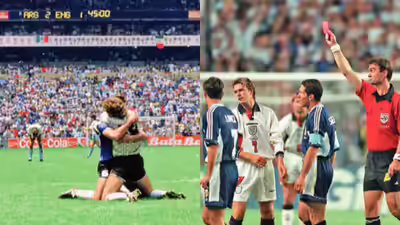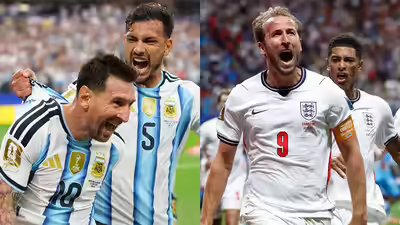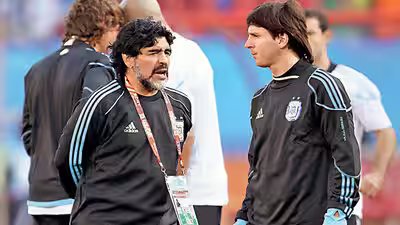
The greatest triumphs are sometimes accompanied by the greatest lows. Ten years ago, at the age of 29 Lionel Messi During his time with Barcelona, which saw him win eight La Liga titles, four Champions League titles and five of his eight Ballon d’Or awards, he decided the pain was enough.“It’s over, that’s it. I worked hard, but nothing happened.” A crestfallen and broken Messi, who missed a penalty in the Copa America final defeat to Chile in New Jersey, announced his “end” and his personal anguish followed the country’s four final defeats – against Germany at the 2014 World Cup, and three Copa Americas (2007, 2015 and now 2016). “It’s so painful not to win the title with Argentina,” he said, letting his frustration be known to all, his face expressing the melancholy of a tortured soul.The world was shocked and awed by the news, with some calling it “Mexico” and many urging him to stay, as social media was immediately flooded with the hashtags #NoTeVayasMessi and #QuedateMessi. Diego Maradona He also expressed support for his disciples, urging him to “fight against all those who forsake him.”Two months later, he was back in the Albiceleste squad as they assembled for World Cup qualifiers against Uruguay and Venezuela, saying he “loved Argentina too much” to stay away. As they say, the rest is history. Between two Copa America titles (2021 and 2024), in which he finally ascended to the legend of the World Cup in 2022 – crowned with the serenity of the colors of La Albiceleste, in 2022 – the legend of Messi was born in his birthplace of Rosario, elsewhere in Argentina and around the world.However, Messi’s burden in the hearts of Argentines has always been complex and subtle. The fate of the kid from Rosario has been intertwined with Maradona’s ever since he decided to leave Argentina and carve out his own legend as a Barcelona player. The resulting content is a rich portrait of the bond between the two World Cup-winning captains, always centered around its inherent vulnerability. With England once again looming on Argentina’s horizon at the World Cup, the question remains: To what extent can Messi and his legacy be Maradona-ized?Forty years ago, the two countries clashed, sending shockwaves through world football, with competition, national identity and the shadow of war intertwined in the 1986 World Cup quarter-finals at Estadio Azteca. It was a Maradona masterpiece, a game in which the Argentine’s magic and playfulness were at work. The ‘Hand of God’ goal was intertwined with deception, highlighting the rivalry and widespread distrust between the two teams four years after the Falklands War. Maradona’s second goal was a cathartic moment.However, the quarter-finals of 1986 may not have been as frantic and emotionally tumultuous as Messi, who was born three years after the Falklands War, is willing to endure on his way to his destiny in Lusail in 2022.Messi’s journey to becoming the master of his legacy has been largely free of Maradona’s paradox, which is why he may have an easier time recreating his mentor’s second Aztec magic.Granted, the second semifinal at the Atalanta Stadium now doesn’t revolve around any tangible concept of Malvinas, but it has its own distinct mental space. This was a “special” game for Messi as it was his first against England, allowing us to see the Whites take on the Three Lions in a match not seen for a generation since 1986.For Argentines, Maradona will always be the rebel and the redeemer. An unknown, accidental manager, Lionel Scaloni, took over a team in a state of evolution after the 2018 World Cup, freeing Messi from his “savior” complex and unleashing a whole new group of players filled with hunger and a “we play for Messi” mentality. One day Leandro Parades said: “We also play for him because we don’t want one day to be his last game with us.“Scaloni’s assistant Pablo Aimar was also hailed as the next No. 10 after Maradona, but failed to lead the national team across the finish line.They suffered together to make Argentina great again. Maybe in a slightly un-Maradona way.