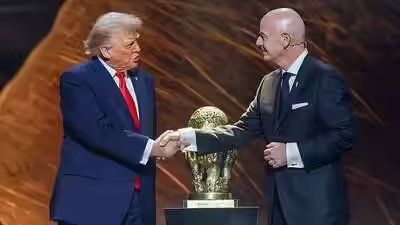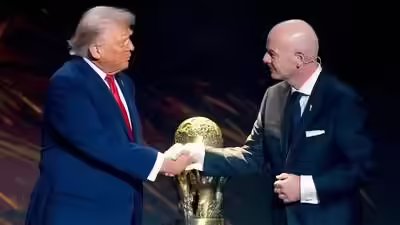
New Delhi: US President Donald Trump He caused major controversy at the FIFA World Cup when he personally asked FIFA president Gianni Infantino to review the red card and one-game suspension of U.S. forward Folarin Balogun, CNN reported.FIFA later announced that Balogun would be eligible for the last-16 match against Belgium after being lifted from the ban, a decision that sparked political debate and raised questions about the integrity of the tournament. “All I did was ask for a review. I didn’t say ‘You have to do this,'” Trump said in the Oval Office, CNN reported, adding that he “didn’t think it was foul play.” “I didn’t tell him what to do, I can’t tell him what to do,” he said, adding that an independent commission “made the right decision.”On Wednesday, in the 2-0 victory over Bosnia and Herzegovina, Balogun, the United States’ top scorer with three goals, received a red card for accidentally stepping on the right ankle of Bosnia and Herzegovina’s Tarik Muharemovic, triggering an automatic one-game suspension.FIFA announced on Sunday it would lift the suspension of the last-16 matches, an extraordinary move that drew praise from Trump and anger from the Belgian team. “Thank you FIFA for doing the right thing and reversing a huge injustice!” Trump later issued a statement on social media.The Royal Belgian Football Association (RBFA) said it was “surprised” as Belgium coach Rudi Garcia mocked FIFA’s actions.“I didn’t know in the FIFA offices that July 5th was April 1st in Europe,” Garcia said in an April Fool’s comparison through a translator. “The Belgian Football Association does not defend itself, nor does it protect the national team. She defends football in general and her integrity and morals. I think this is the first time in the history of the World Cup that such a decision has been made. “FIFA said its decision was based on Article 27 of the Disciplinary Committee Rules.“The judicial authorities may decide to suspend the execution of disciplinary measures in whole or in part,” the rule states. “The judicial authorities, by suspending the execution of sanctions, impose a suspended sentence of one to four years on the sanctioned person.”